Showing posts with label album art. Show all posts

Friday, June 17, 2016

92. Kate Bush - Never for Ever


Flickr Download DeviantArt


Some record  album covers  translate okay to a smaller size – whether it be a CD booklet or a computer  thumbnail image.  Others, however, have rich  detail which  gets lost when the image is reduced.
Kate Bush’s 1980 album Never For Ever is one such album.

Painted by artist Nick Price, who had previously  provided the cover art for Bush’s 1979 Tour program, it features a myriad of fantastical creatures flying out from under her windblown skirt.  Symbolizing
dark and light,  a fang-baring bat and a swan are the  most predominant.  Bush described the cover as  “an intricate journey of our emotions:  inside gets outside,  as we flood people and things with our
desires and problems. These black and white thoughts, these bats and doves, freeze-framed in flight, swoop into the album and out of your hi-fis. Then it’s for you to bring them to life.” (Kate Bush Club newsletter, Sept. 1980) Music to Eat


My own personal observation  is that Nick Price  (at the instance of Kate)  was portraying a dreamy surrealism  in the tradition of the Early Netherlandish painter Hieronymus Bosch.  This album cover art
bears semblance  with The Garden of Earthly Delights which is attributed to Bosch.  In the work above, the original album cover art design is at extreme left.  Its right half was flipped and added on the
right in order to mirror itself. The unflipped right half was added farther on the right in order to mirror the flipped half. I would call this a 'Bush flip', somewhat the opposite of but not very much unlike
a Bosh triptych.


While the art of the  older masters was  based in  the physical  world of everyday experience,  Bosch confronts  his viewer with,  in the words of  the art historian  Walter Gibson,  "a world of dreams and
nightmares in which forms  seem to flicker and change before our eyes".  In one of the first known  accounts of Bosch's paintings, in 1560 the  Spaniard Felipe de Guevara  wrote that Bosch was regarded
merely as  "the inventor of monsters  and chimeras".  In the early  seventeenth century,  the artist-biographer  Karel van Mander  described  Bosch’s work as  comprising  "wondrous and strange fantasies";
however, he concluded that the paintings are "often less pleasant than gruesome to look at". wiki


Here's the work of Nick Price.


Painting by Nick Price, direction by Kate Bush. Album produced by Kate Bush and Jon Kelly. EMI (UK), EMI America (USA), Harvest (Canada) 1980.


Never for Ever has Kate Bush  sounding vocally stable and more confident,  taking what she had put into her debut single "Wuthering Heights"  from 1978 and administering  those facets into most of the
album's content.  Bush's dramatics and theatrical approach to singing begin to solidify on Never for Ever, and her style brandishes avid seriousness  without sounding flighty or absurd.  "Breathing," about
the repercussions of nuclear war, conveys enough passion and vocal curvatures to make her concern sound convincing, while "Army Dreamers" bounces her voice up and down without getting out of hand.
"Babooshka"'s  motherly charm  and flexible  chorus make it one of her best tracks, proving that she can  make the  simplest of lyrics work for  her through  her tailored vocal acrobatics.  The rest of the
album isn't quite  as firm as her singles,  but they all sport a more  appeasing and accustomed sound than some of her past works,  and she does manage  to keep her identity and  characteristics intact.
Mike DeGagne for AllMusic; abridged.


(A) Babooshka - Delius (Song of Summer) - Blow Away (For Bill) - All We Ever Look For - Egypt

(B) The Wedding List - Violin - The Infant Kiss - Night Scented Stock - Army Dreamers - Breathing


"Babboshka" music video from KateBushMusic on YouTube


Back to Gallery 3


Sunday, May 1, 2016

86. Elton John - Captain Fantastic & The Brown Dirt Cowboy


Flickr Download DeviantArt


This work is derived not from the original album cover art design but from the album's promotional poster that came with the album, released in 1975. Icons on the bottom left and bottom right of the
original image have  been removed and portions  on the sides have been extended with the use of the Liquify filter.  The contrast and brightness  were the adjusted and the whole image was stretched
and sharpened with the use of Crosshatch.

Folded at centre with the artist's name added at lower right and without the calligraphy at the bottom,  the original poster served as the album's  gatefold cover.


The album cover art by Alan Aldridge  features images of Elton John,  Bernie Taupin and the band (animated  elements of the artwork were used in a 30-second  television commercial  celebrating the
release of the album).  The front panel shows Elton breaking out of a dangerously dreary cityscape astride his piano while the back of the cover shows Bernie writing in a somewhat  protected pastoral
bubble. Keen-eyed fans can also identify Elton’s first music publisher Dick James and Bernie’s then-wife Maxine in the intricate illustration. www.eltonjohn.com


Bruce David Janu on The Vinyl Voyage: "When I was a kid, I used to check out record  albums from the public library. I was perusing  the LP bins one day and came
across Captain Fantastic and the Brown Dirt Cowboy.  At the time I was perhaps 10 years old and knew nothing about Elton John,  other than the crazy outfits and
sunglasses he wore.  

Anyway, I checked out Captain Fantastic not because it was Elton John, but because the cover was so awesome. Although I hadn't yet been exposed to Hieronymus
Bosch, the cover must have been influenced by the paintings of the 15th century artist.  When I studied art in college I remember looking at The Garden of Earthy
Delights and immediately thinking of Captain Fantastic.  Like Bosch, the cover to Captain Fantastic is filled with other-worldly creatures: birdmen, naked bodies,
giant fish, men carrying large timepieces, creatures pooping gold. The only thing missing from the Elton cover is a man playing a flute out of his ass.

Captain Fantastic and the Brown Dirt Cowboy came out in an era when album art mattered and bands spent a great deal of time and energy making the album art
part of the entire experience.  The packaging was almost as  important as the contents.  First, the introduction of compact discs diminished album art importance
and the evolution  to digital  completely killed this  time-honoured tradition.  The art of Captain Fantastic and the Brown Dirt Cowboy  could never be shrunk to a
small LCD screen. Indeed, an album like Captain Fantastic would not even be produced today."


This is the original poster art.


This is the original album front cover.

No. 158, Rolling Stone, The 500 Greatest Albums of All Time; No. 173, The Virgin All-Time Album Top 1000.


Original album art design and poster by Alan Aldridge. Album produced by Gus Dudgeon. MCA (USA), DJM (UK) 1975.


Written, according to lyricist Bernie Taupin, in chronological order,  Captain Fantastic is a concept album that  gives an autobiographical  glimpse at the struggles John (Captain Fantastic) and Taupin
(the Brown Dirt Cowboy) had in the early years of their musical careers in London (from 1967 to 1969). The lyrics and accompanying photo booklet are infused with a specific sense of place and time
that would otherwise be rare in John's music. John composed the music on a ship voyage from the UK to New York.

"Someone Saved My Life Tonight",  the only single released from the album  (and a number 4 hit on the US Pop Singles chart),  is a semi-autobiographical  story about John's disastrous engagement to
Linda Woodrow,  and his related 1969 suicide attempt.  The "Someone" refers to Long John Baldry,  who convinced him to break off the engagement rather than ruin his music career for an unhappy
marriage. It was viewed by Rolling Stone writer Jon Landau as the best track on the album: "As long as Elton John can bring forth one performance per album on the order of 'Someone Saved My Life
Tonight', the chance remains that he will become something more than the great entertainer he already is and go on to make a lasting contribution to rock." wikipedia


(B) (Gotta Get a) Meal Ticket - Better Off Dead - Writing - We All Fall in Love Sometimes - Curtains


"We All Fall in Love Sometimes" live from blog.naver.com/mvez on YouTube.


Previous: Patti Smith - Horses
Back to Gallery 3


Friday, April 22, 2016

83. Oasis - Definitely Maybe


On this work, the original album art was cropped at the top and stretched horizontally to produce an image 9x5 in LW ratio, four of which can fit into an 18x10 resolution screen. 
The resulting image  was then positioned at top left.  The image was next reproduced and flipped horizontally  and the resulting image  was placed at top right. The two
images were then  mirrored to fill the  remaining space and  the shades were  added to add dimension and depth.  Finally, the whole  image was  processed with
the craquelure filter and the contrast and brightness were adjusted. 


The initial idea for Definitely Maybe came from the back cover to A Collection of Beatles Oldies, which was a group photograph of the Beatles gathered round a small table in a 
Japanese hotel room.  Oasis had decided that a similar group  photograph should be taken in Bonehead’s front living room.  I’d already heard the  album many times and
knew that it was  a great challenge to  create an image suitable for the cover.  I was therefore horrified when I went to recce the room and  saw how small and
uninspiring it was.


Photo from Thrifty Vinyl

The band had assumed that I would take the photograph looking into the room with the bay window as a source of illumination – in other words, the opposite direction to how it 
finally appeared on the cover. To me, the bay window was the most interesting feature of the room and so I decided to take the unusual step of shooting into the light of
the bay window. I then lit the room accordingly to avoid the band appearing as silhouettes. The room was made to look bigger by using a wide-angle lens but this 
created a problem with the floor. The stripped flooring had been transformed into this huge ‘desert’ expanse which overwhelmed and dominated the shot.
The empty space and what to do with it became a real problem. A week before the shoot I had visited the Egyptology section at the Manchester
Science Museum and, as a result, the whole notion of lying in a preserved state and the way the Egyptians honoured and represented their
past kings was very much fresh in my mind. The idea then occurred to me to have Liam Gallagher lying outstretched and motionless
on the floor, with his head towards the camera and with his eyes closed: a rock icon ‘lying in a state’ or indeed some other
transcendental state, but not of this world.

Definitely Maybe has to be one of the best covers I did for Oasis and I know the band themselves were really pleased with it.
Michael Spencer Jones for Oasis Recording Information


The artwork for Definitely Maybe warrants scrutiny.

The large image of Burt Bacharach in the bottom left of the artwork is, first and foremost, a straightforward homage to one of Noel's musical heroes but the positioning of 
the picture is also significant.  It is reminiscent  of where Pink Floyd  positioned the artwork for the  soundtrack to the film, Gigi, on the cover of their 1969 album,
Ummagumma. One presumes this was Noel's nod to the prog rockers, rather than the Vincente Minnelli musical film.

There is a small photograph of Manchester United legend George Best in the window, which was guitarist Bonehead's defiant reminder that not every member of Oasis is a 
Manchester City fan.

The Good, the Bad and the Ugly is playing on the television. Noel has since declared that this Clint Eastwood western is one of his favourite films.

Inevitably, if Bonehead was having a picture of a Manchester United player, the Gallagher brothers were going to have a bigger picture of a Manchester City legend. And
who else but Rodney Marsh, the club's record signing, who scored 35 league goals in 116 appearances.

(Of the empty glass and ashtray), nothing too cryptic here, just a nice reference to the track, "Cigarettes and Alcohol." Rupert Hawksley for The Telegraph


No. 44, The Virgin All-Time Album Top 1000.


Sleeve concept, design and art direction by Brian Cannon for Microdot, photo by Michael Spencer Jones.
Album produced by Oasis, Mark Coyle, Owen Morris and David Batchelor. Creation 1994. 


(A) Rock 'n' roll Star - Shakermaker - Live Forever

(B) Up in the Sky - Columbia - Sad Song

(C) Supersonic - Bring It On Down - Cigarettes and Alcohol

(D) Digsy's Dinner - Slide Away - Married with Children


"Shakermaker" music video from OasisVEVO on YouTube.


Previous: Beastie Boys - Paul's Boutique

Back to Gallery 3


Thursday, March 24, 2016

81. Santana - Abraxas


Flickr Download DeviantArt


Annunciation is the first painting I painted after my initial New York awakening.  I was 28 years old and at the peak of my molecular bio-energy.  You can feel the sudden burst of the
Big Apple's electric zap in the composition after all the early years of adolescent brooding over potatoes and eggs and the romantic nostalgia of the preceding Flight to Egypt.

In those days I had an obsessional passion for the female body that lasted deep into my thirties (to be replaced by rocks 'n' stones). . .

Years later Carlos Santana saw a reproduction of the Annunciation in a magazine and wanted it for the cover of his all time best selling Abraxas album.  It did me a world
of good. I saw the album pinned to the wall in a shaman's mud hut in Niger and inside a Rastafarian's ganja hauling truck in Jamaica.  I was in good global company,
muchissimas gracias, Carlito!

The text above is edited extracts from Mati Klarwein's book 'Collected Works 1959-1975'. www.martiklarweinart.com


The image of the original painting was Crosshatched and positioned at right. The images of the angel and Carlos with guitar at left were added. The calligraphy
"mi ritmo bueno pa gozar!" is mine. The Abraxas angel is from SantanAmigos, Carlos' photo is from SlipStreamRadio.  


This is the original painting.  


No. 58, Rate Your Music, The 100 Greatest Albums of All Time; No. 202, The Virgin All-Time Album Top 1000;
No. 207, Rolling Stone The 500 Greatest Albums of All Time; No. 244, Billboard, The 300 Best-Selling Albums of All Time.

No. 13, Rolling Stone, The 100 Greatest Album Covers.


Album cover from a painting by Mati Klarwein. Album produced by Fred Catero & Carlos Santana. CBS 1970.


Abraxas was a word of mystic meaning in the system of the Gnostic Basilides, being there applied to the "Great Archon", the princeps of the 365 spheres. The word is found in Gnostic
texts such  as the Holy Book  of the Great  Invisible Spirit,  and also  appears in the Greek Magical Papyri.  It was engraved  on certain  antique gemstones,  called on that account 
Abraxas stones, which were used as amulets or charms. As the initial spelling on stones was 'Abrasax', the spelling of 'Abraxas' seen today probably originates in the confusion 
made between the Greek letters Sigma and Xi in the Latin transliteration.

The seven letters spelling its name may represent each of the seven classic planets. The word may be related to Abracadabra, although other explanations exist.

There are similarities and differences between such figures in reports about Basilides's teaching, ancient Gnostic texts, the larger Greco-Roman magical traditions, and modern 
magical and  esoteric writings.  Opinions  abound  on Abraxas,  who in recent centuries has been claimed  to be both an Egyptian  god and a demon.  The Swiss psychiatrist
Carl Jung wrote a short Gnostic treatise in 1916 called The Seven Sermons to the Dead, which called Abraxas the supreme power of being transcending both God and
devil and unites all opposites into one being. Wiki


Abraxas was deemed "culturally, historically, or artistically significant" by the Library of Congress and was selected for preservation in their National Recording Registry in 2016.


The San Francisco Bay Area brock scene of the late '60s bwas one that encouraged  radical experimentation  and discouraged the  type of mindless conformity  that's often
plagued corporate rock. When one considers just how different Santana, Jefferson Airplane, Moby Grape, and the Grateful Dead sounded, it becomes obvious just
how much it was encouraged. In the mid-'90s, an album as eclectic as Abraxas would be considered a marketing exec's worst nightmare. But at the dawn of
the 1970s,  this unorthodox  mix of rock, jazz, salsa, and blues proved  quite successful.  Whether adding  rock elements  to salsa king Tito Puente's
"Oye Como Va," embracing instrumental jazz-rock on "Incident at Neshabur" and "Samba Pa Ti," or tackling moody blues-rock on Fleetwood Mac's
"Black Magic Woman," the band keeps things unpredictable yet cohesive. Many of the Santana albums that came out in the '70s are worth
acquiring, but for novices, Abraxas is an excellent place to start. AllMusic review by Alex Henderson. 


(A) Signing Winds, Crying Beasts - Black Magic Woman/Gypsy Queen - Oye Como Va - Incident at Nashibur

(B) Se a Cabo - Mother's Daughter - Samba Pa Ti - Hope You're Feeling Better - El Nicoya


"Oye Como Va" live from RockAndDiscoMusic on YouTube.


Friday, March 18, 2016

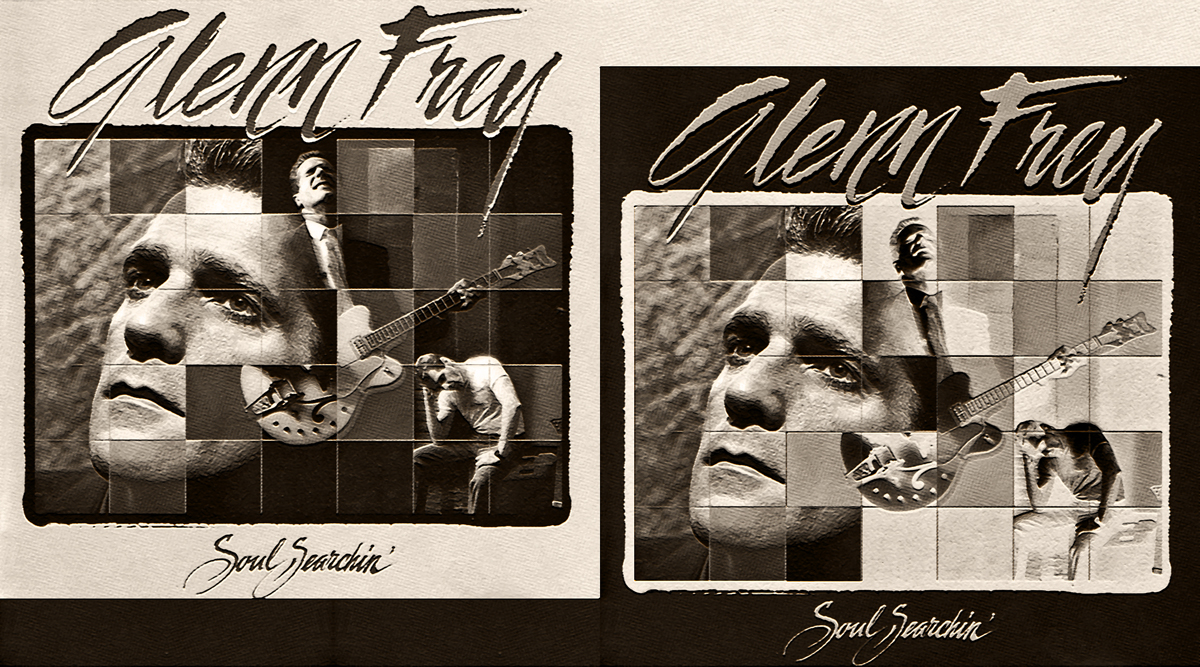
80. Glenn Frey - Soul Searchin'


Flickr Download DeviantArt


Upon hearing news of his death on 18 Jan 2016, I decided to abandon my list of "things to do" on this blog to insert a kind of tribute to one of my idols in music.
This is the album cover art design I chose to work on. As a solo album, critics have said that this is not his best, but for a tribute, this one fits best. 

On this work, the original album cover art design is at left. Some of its parts have been converted to negative and the processed image is positioned at
lower right. Strips of colour were added to fit the new image into an 18X10 resolution screen. It was then processed in sepia and texturized. 

Live on, Glenn Frey. Take another shot of courage.


"Take another shot of courage
Wonder why the right words never come
You just get numb
It's another tequila sunrise, this old world
Still looks the same
Another frame."
from "Tequila Sunrise" genius


Don Henley says: "I believe that was a Glenn title. I think he was ambivalent about it because he thought that it was a bit too obvious or too
much of a cliché because of the drink that was so popular then. I said, 'No - Look at it from a different point of view. You've been
drinking straight tequila all night and the sun is coming up!' It turned out to be a really great song.'"

Henley said that Frey came up with changes for the bridge, and that "take another shot of courage" refers to tequila because they used
to call it "instant courage." He said: "We very much wanted to talk to the ladies, but we often didn’t have the nerve, so we’d
drink a couple of shots and suddenly it was, "Howdy, ma’am?"" Wiki


This is the original album cover art design.


Eight years after the demise of the Eagles, Glenn Frey had settled into a career that involved writing the occasional movie
theme song, taking the occasional acting role, and, every four years, turning out another album of light soul-pop tunes
written with Jack Tempchin. Soul Searchin' showed him to be more interested in body building than record making
(he was also  appearing in health  club before-and-after  ads at this time),  and the songs here were so inter-
changeable  with those on  his first two albums  he apologized for  it in his note about "True Love," which
became the album's sole Top 40 hit. The music was pleasant, but inconsequential, and suggested that
Frey, living off his Eagles royalties, had come to think of his solo career as a hobby.
William Ruhlmann for AllMusic


When Frey was asked about his musical direction, he said "In a sense I'm working my way back home, Though I left
Detroit and went to  California to cut my  teeth on country-rock,  I've remained obsessed with  the music of my
adolescence,  the great  soul hits  of the 60's  and early 70's.  It's a  style that  most  black musicians  have
abandoned for dance music and rap. There are a whole lot of people who miss the sound of Sam & Dave,
and Wilson Pickett. It's left a gap that is being filled by people like Steve Winwood." Wiki


Information wanted for original album cover art design and photo.
Album produced by Glenn Frey, Barry Beckett & Elliot Scheiner. MCA 1988.


(A) Livin' Right - Some Kind of Blue - True Love - Can't Put Out This Fire - I Did It for Your Love

(B) Let's Pretend We're Still in Love - Workin' Man - Soul Searchin' - Two Hearts - It's Your Life

"True Love" live from negipin on YouTube.


Monday, March 7, 2016

79. The Jimi Hendrix Experience - Axis: Bold as Love


Flickr Download DeviantArt


I've always been fascinated with the way religious fervour could inspire great art and to me this holds true whether one is talking about Western or Oriental art - or religion for that matter.
In the case of this cover art design, I just tried to tweak the image any way I can hoping to find the best effect and to create what to me would make a good and unique screensaver
without a care for meanings. This is rock and roll, I thought, this is about the music. But of course, I was also aware that there was some sort of connection between the cover
art design and the music contained in the record beneath it. It was only when I finished the work and was starting to look for references to it when I found out the real
meaning of this art - and the controversy behind it.


First of all there was the Hindu painting known as Viraat Purushan-Vishnuroopam, an 
iconographical form and theophany of the Hindu god Vishnu or Krishna. . .

Photo from carnaticcorner.com

. . . and this photo of the band by Karl Ferris. . .


 Photo from feelnumb

. . . which the artist Roger Law combined in order to produce the album cover art.


Jimi Hendrix expressed dismay regarding the album cover art, which depicts him and the Experience as various forms of Vishnu, incorporating a painting of them by Roger Law, from
a photo-portrait by Karl Ferris. Hendrix stated that the cover would have been more appropriate had it highlighted his American Indian heritage. The painted image of the
Experience was then superimposed on top of a copy of a mass-produced religious poster. Hendrix commented: "The three of us have nothing to do with what's on the
Axis cover." Hindus have since expressed anger on the appropriation of the deity Vishnu for the album cover and poster. The Malaysian government's Home Ministry
instituted a ban on the artwork from June 2014 to protect religious sensitivities following complaints. wikipedia


No. 59, Rate Your Music, The 100 Greatest Albums of All Time; No. 83, Rolling Stone, The 500 Greatest Albums of All Time;
No. 147, The Virgin All-Time Album Top 1000.


Cover design by David King & Roger Law, photo by Karl Ferris. Album produced by Chas Chandler, Track 1967.


(A) EXP - Up from the Skies - Spanish Castle Magic - Wait Until Tomorrow - Ain't No Telling - Little Wing - If 6 Was 9

(B) You Got Me Floatin' - Castles Made of Sand - She's So Fine - One Rainy Wish - Little Miss Lover - Bold as Love


"Little Wing" covered live by Eric Clapton & Steve Winwood from Betina Vallandro on YouTube.